What are the disadvantages of a cash management account?
Posted on May 8, 2026

I switched our main checking account – the one that gets our Social Security checks and that I use to pay all bills – from my bank at PNC to a “cash management” account at Fidelity. I had three reasons: 1) It’s easier to transfer money back and forth from our investment account at Fidelity. 2) I can now use or investment account as our overdraw protection for the checking account. 3) It bugged me to earn essentially nothing on cash balance in our checking account; my interest rate at PNC was 0.01%. The only disadvantage was the time to set it up, but this was straightforward.
I still have the checking account at PNC. It’s a $0 cost account. I have $200 in it. I can always transfer cash from our Fidelity account to this PNC account if I want to get more cash than I would normally get at an ATM that uses my debit card from our Fidelity account (no ATM fee). Bill Pay there is still active, but I’m using Bill Pay at Fidelity now.
== What’s a “cash management account”? ==
A cash management account is a brokerage account that you use like a checking account. It holds no investments. The main advantage is that you earn more than 0.01% annual rate that banks pay on your cash balance. You pick how you want the cash balance to be invested: an FDIC insured sweep account at ~2% interest or US government money market at ~3% now.
== I found these advantages ==
I login one place to see checking and investments. Our checking account is easy to pick out. It’s in its own category with the appropriate “nickname.”
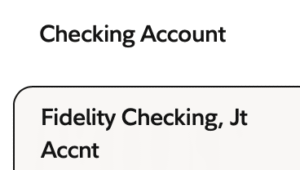
Fund transfers between our investment account and checking are instantaneous. Transfers between Fidelity and PNC could drift to the next day.
Our Fidelity investment account is the overdraft protection for our Fidelity checking account. Any cash there is earning 3%.
I earn ~300 times the interest I earned at our PNC checking account. I earned more money market interest (dividends) in the first month than I have earned in 20 years at PNC. In the grand scheme of things, it’s not a lot per month. Over ten years, though, the added income invested adds to a couple of $1,000 in today’s spending power. I wish I had done this years ago.
== Disadvantages ==
I had to spend time to switch. The actual time spent to set it up was maybe a couple of hours. I had to give the new routing and account number to seven auto debits (utility and insurance bills) and three-monthly auto deposits. I had to enter ~ten payees that I regularly pay by check at least once in a year.
I had to wait to make sure all the auto debits and deposits were working correctly. Social Security was the laggard; it took two or three months for them to complete the change.
The monthly “bank statement” is in a slightly different format than I’m used to when I reconcile the checkbook each month, and takes a few minutes longer than before. (None of my friends here bother to reconcile their checkbook!)
I was getting an email on every deposit and debit. Those started to bug me. I had to call Fidelity to figure out how to turn off these alerts.
Conclusion. I switched our main checking account – the one that gets our Social Security deposits and that I use to pay all bills – from a checking account at PNC to a “cash management” account at Fidelity. Life is a bit simpler: I have one fewer place to log in for my financial tasks; our investment account at Fidelity is our overdraft protection account; we get 300 times the interest than we did at PNC.
The only disadvantage was the time to set it up. The task was straightforward. I had to wait a month or two to make sure the auto debits and the SS deposits worked correctly.