Should I put one year of spending into FFRHX?
Posted on August 7, 2026

Every now and then I scratch my head: is there something better than IUSB, our index fund for US bonds? I look at two kinds of funds in this post: funds that buy and hold short-term, high interest loans banks make to their customers and one that buys and holds US Treasury short term Inflation-Protected Securities (TIPS).
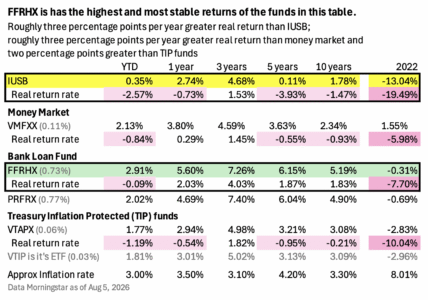
I plan to put one year of spending into FFRHX, a fund that buys and holds short-term loans by banks to their customers. It outperformed our IUSB by about three percentage points per year over the last ten years and the TIPS fund I show by two percentage points per year. FFRHX also held up much better in 2022, the year that bonds funds with longer average maturity dates tanked to their worse one-year return in history.
== IUSB ==
I chose IUSB for our portfolio in 2014. It’s an index fund that holds a bit of all US bonds: nearly 18,000 securities. I think it hold more securities than any other bond fund. The average maturity is about 5.5 years. That falls in the category of an intermediate bond fund.
Over the last 100 years, US treasury intermediate bonds have returned 2.1% real return. Over the last ten years, and especially in 2022, they have been well below that. IUSB roughly matches their ten-year return rate, but was worse than this index in 2022.

== Bonds are insurance ==
We hold bonds as insurance, the thing we will sell to get cash for our spending when we don’t want to sell stocks. We know stocks can crater, and we want to disproportionately or solely sell bonds to give them time to recover. Patti and I now have about 3½ years of spending in bonds. That means we can go +4 years before we would have to sell stocks.
Bonds have been terrific insurance when stocks cratered. They averaged nearly 20 points better in return for the ten worst years for stocks out of the last 100 EXCEPT FOR 2022. Stocks declined -23% real return, their sixth worst year in the last 100. Bonds (in general) fell even more. That was their worst year in history, and 2021 ranked in the top ten worst years.
It was a bummer to sell bonds at the end of 2022 for our spending for 2023 after they tanked, but I still wanted to give stocks time to rebound and they did fairly quickly. It was a bummer later to have to sell more stocks just to buy more bonds to get them back to my design mix.
Selling stocks just to buy bonds is not an unusual event. If I’ve counted correctly, I’ve sold solely stocks for our spending in six of the past 11 years. Stocks have outperformed bonds by a wide margin in those years. I’ve then sold more stocks those years to buy bonds to rebalance our portfolio or get them back to our desired number of years of spending.
== The ideal ==
I’d like bonds to steadily earn, say, 2% real return.
I want bonds to hold up when stocks crater. After 2022, I weight this insurance value more than the amount of return.
== Two other types of bond funds ==
This short video describes two different kinds of funds. Two funds buy short term, high interest (higher risk) loans made by banks or other financial institutions. One buys shorter term (less than five-year) US Treasury Inflation-Protected Securities (TIPS). The video is from March 2022 and was the right call as interest rates rose steeply in 2022 and longer-term bond prices fell.
I gathered data on the three mentioned. I display others. See here for pdf.
== One fund stands out: FFRHX ==
One fund stands out to me: FFRHX, Fidelity Floating Rate High Income Fund. It’s actively managed, which I don’t like, but it has earned about three percentage points greater real return per year than IUSB; three percentage points greater than money market; and two percentage points greater return than the TIPs fund.
I plan to put at least one year of spending into FFRHX.
Conclusion: This post displays two different kinds of bond funds and compares them to my IUSB. Two funds buy and hold short-term, high interest loans banks make to their customers and one fund buys and holds US Treasury short term Inflation-Protected Securities (TIPS).
The standout is FFRHX, Fidelity Floating Rate High Income Fund. It invests in riskier loans but has beaten the IUSB that Patti and I own by about 3 percentage points greater real return for all periods over the last ten years. It similarly beats a fund that invests in Treasury Inflation Protected Securities by two percentage points.
I plan to put at least one year of spending in FFRHX.